
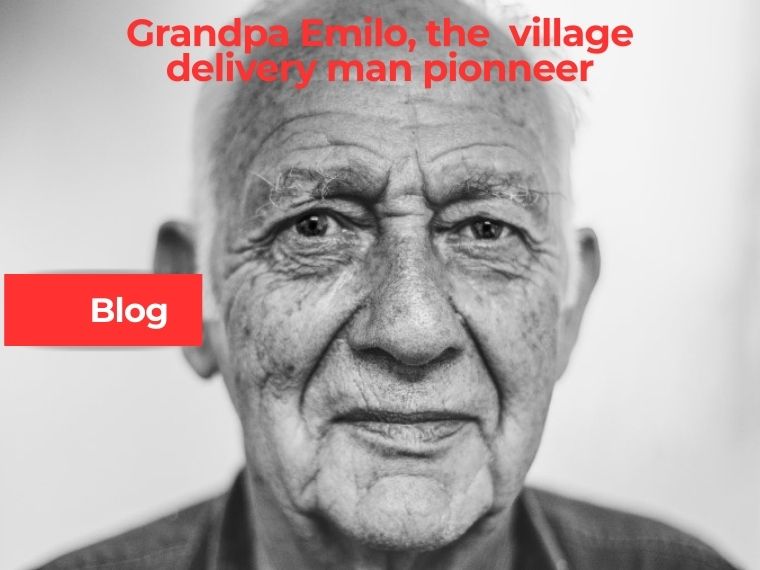
His name was Emilio. But everyone called him Grandpa Emilio.
He was a tall man, weathered by decades of field work, with that particular kind of face that southern Spanish sun and hard labour carves into people: lined, leathery, and somehow timeless. He walked with a limp that slowed nothing but his comfort. I couldn’t tell you his age. Somewhere between old and ancient, I suppose.
Old Emilio was a fixture in my childhood neighbourhood on the coast of Granada. He appeared most mornings, grandchildren occasionally in tow, doing small favours for his daughter and the neighbours around her. Carrying a bag here. Picking something up there. And then — somewhere in that quiet rhythm of small acts — a business was born.
I thought about Old Emilio recently while reading about Amazon’s latest push into ultra-fast fresh food delivery in the UK: human shoppers walking supermarket aisles, filling online orders, delivering them within the hour. And I thought: *Well. That’s just Grandpa Emilio with a fancy smartphone and a Prime badge.*
What Emilio had built — entirely without knowing it, without a business plan, a pitch deck, or a single line of code — was a last-mile logistics operation for perishable goods in a low-trust, high-frequency market.
In logistics, the “last mile” is the hardest part. Not because the distance is long, but because it is “intimate”. The last mile is where supply chain meets human being. Where a box becomes a dinner. Where reliability becomes loyalty.
Emilio received his orders the way pre-digital humans always did: shouted from balconies as he passed, or scribbled on tiny scraps of paper delivered by neighbourhood children while he smoked on the bench in the little square. He served two stores. He knew the streets. He knew the clients. And he delivered.
What Amazon is reinventing — with algorithmic routing, real-time inventory feeds, and geofenced delivery windows — is, at its philosophical core, exactly what Old Emilio did intuitively. The technology is different. The insight is the same.
Here’s the part that genuinely delights me.
Emilio had a mental customer database that would make any SaaS founder envious. No software. No dashboards. Just a lifetime of quiet observation.
He knew which neighbours placed frequent, modest orders with small tips. These were his “bread-and-butter accounts” — low margin, high volume, essential for daily cash flow. He served them first.
He knew which neighbours tipped generously but only called on him occasionally. These were his “high-value occasional clients” — worth keeping warm, never worth ignoring.
And he knew who made him wait at the door, who changed their minds, who gave him grief. These he quietly “de-prioritised”. No confrontation. No cancellation email. The village grapevine — that original social network — did the rest. Word got around: if you wanted the service, you treated Emilio right.
I’ve learnt that this is, in almost every technical detail, what modern behavioural economists call “Recency-Frequency-Monetary (RFM) segmentation”. It is how Netflix decides what to recommend, how airlines decide who gets upgraded, how every subscription box company decides who to retain and who to let churn. Emilio just did it with his brain, in real time, because his livelihood depended on getting it right.
Back into our business. There is a reason that fresh produce is where delivery platforms go to prove themselves — and where many of them die trying.
Unlike a book or a phone charger, a lettuce has an opinion about time. It is not patient. It does not tolerate a failed delivery attempt, a day in a warm van, or a customer who isn’t home. In the fresh produce business, “the product and the clock are in a constant negotiation” and the logistics system has to respect both.
Emilio understood this instinctively. He chose the eggs without cracks. He selected the vegetables that wouldn’t bruise. He checked the yogurt dates. He packed the bags so that nothing would collapse under its own weight. He was, in the language of supply chain management, performing “quality gatekeeping at the point of fulfilment” — ensuring that variability in the product did not translate into variability in the customer experience.
This is the essential tension in fresh produce delivery: you cannot control what the field gives you, but you can control what reaches the customer’s door. Emilio’s value was not in walking to the store. Any child could do that. His value was in knowing what to bring back — in exercising judgment about freshness, quality, and selection that his clients could not exercise for themselves from their balconies.
That judgment, in 2024, is still the hardest thing to automate.
There’s a postscript worth adding to the story.
A few years ago, a story circulated in American business media about young entrepreneurs who had discovered a brilliant new strategy: buying heavily discounted products from Walmart and Costco during promotions, then reselling them on Amazon at full price, pocketing the difference throughout the year.
The stories were told with breathless admiration, as if someone had discovered fire.
Bert would have smiled. This is arbitrage — one of the oldest economic principles in existence. The idea that price differences across markets, time, or information create profit opportunities is as old as the Silk Road. What changes is the platform. What never changes is the human insight that sees the gap and fills it.
The “innovation” was not the strategy. The innovation was Amazon’s marketplace, which turned a local arbitrage game into a scalable one. But the instinct? That belongs to every market trader, every village errand man, every farmer who has ever held back a crop waiting for prices to rise.
The fresh produce industry has a complicated relationship with innovation. We are quick to adopt new technologies — cold chain sensors, automated irrigation, optical electronic grading — but slow to acknowledge that many of the problems these technologies solve are problems that experienced people once solved with nothing but accumulated knowledge and good judgment.
There is a concept in evolutionary biology called convergent evolution: the idea that completely different species, facing the same environmental pressures, independently arrive at the same solutions. The eye evolved separately in vertebrates and molluscs. Wings evolved separately in birds, bats, and insects. The solution is not the point — the problem is the point.
Old Emilio and Amazon Fresh are convergent evolution. Same problem: get fresh food to people who want it, at the moment they want it, in good condition. Different contexts. Different tools. Identical logic.
The lesson is not that old is better, or that new is better. The lesson is that wisdom embedded in practice — the kind that comes from years of getting it wrong, adjusting, and getting it less wrong — has real value. And in an industry as complex and volatile as fresh produce, that wisdom is neither outdated nor transferable by algorithm alone.
Sometimes I fancy that I would like to see Old Emilio face while a drone deliver a bag of clementines to a third-floor balcony on a Wednesday morning.
We may need to wait a little longer for that but I am sure sure that Old Emilio would nod in approbation:
“Hell, Yeah”. “That’s the job”, he’d say. That’s always been the job.
