
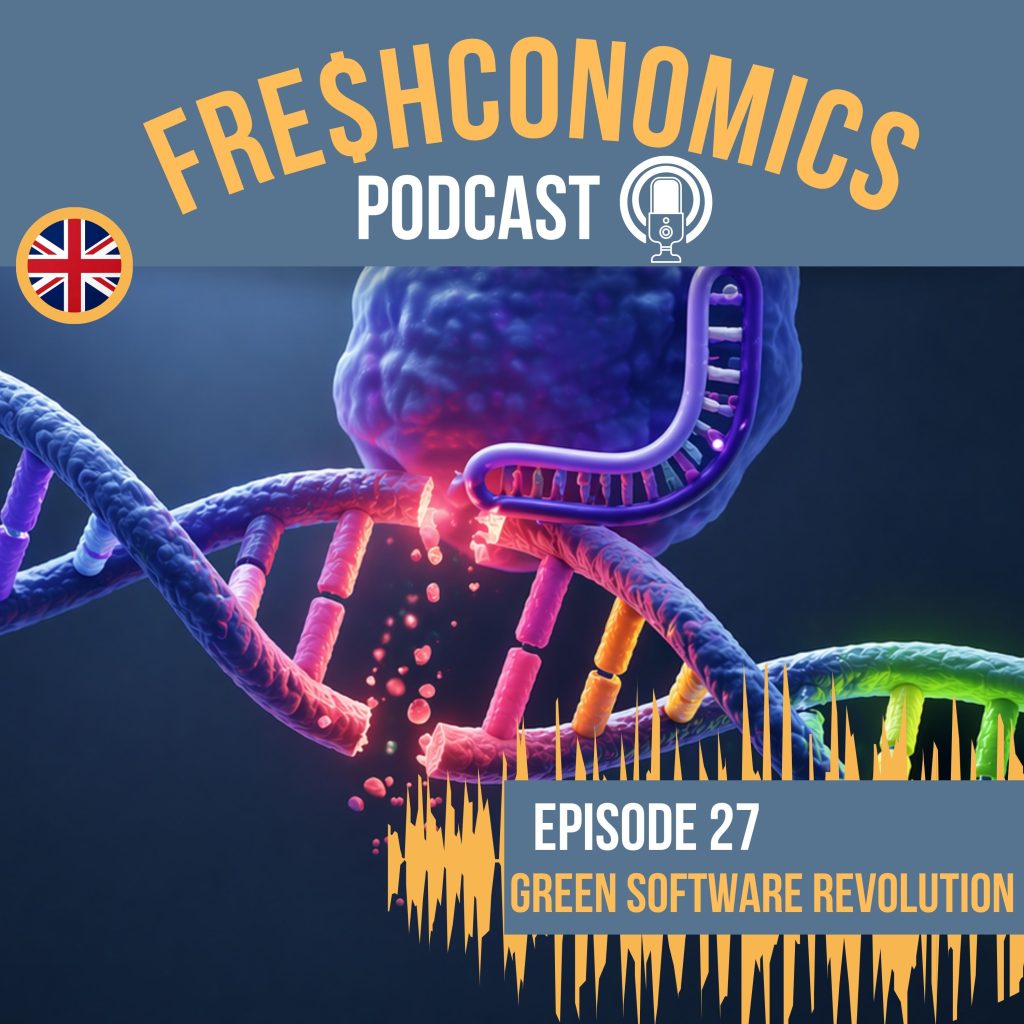
I’d love to see Robert Jacques Turgot’s face — the 18th-century French economist who first identified the law of diminishing returns — as he walks into a modern gene-editing lab. He’d finally find the answer to a question that haunted him nearly 250 years ago: what happens when you hit the ceiling of what land can produce?
In this episode, Turgot’s centuries-old economic law is connected to one of the biggest regulatory shifts in recent European history: the December 2025 EU agreement opening the door to gene-edited crops. It’s a story that runs from 1960s wheat fields to CRISPR-edited tomatoes, and it reframes how we should think about the future of agriculture.
The core idea is this: if the Green Revolution of the 1960s raised agricultural yields by intensifying inputs — more fertiliser, more irrigation, more machinery — the upcoming Green Software Revolution works differently. It doesn’t add more to the field; it rewrites the plant itself, the way a programmer edits lines of code. A drought-resistant tomato, a browning-resistant apple, a virus-immune banana. These aren’t incremental gains, they’re a change in the source code of food.
But if food becomes programmable, who owns the code? Can we draw a parallel to the Android-versus-iOS battle in tech? … and maybe ask what it means for growers if the real power shift upstream, toward whoever holds the patents.
Tune in to listen to this futuristic narrative about Turgot’s law limitations, New Genomic Techniques (NGTs) and the economics of platform control. This episode may change how you look at the produce aisle.
Welcome to a new episode of Freshconomics Podcast.
Enjoy this episode on your favourite platform

📙 And get your copy of the book Freshconomics here: Paperback, Ebook
