
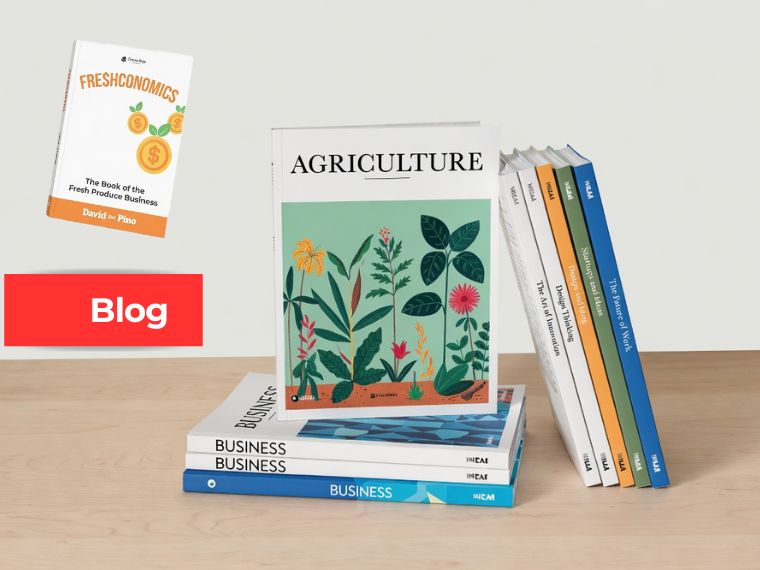
For many years (20 years or so), as I was writing Freshconomics, I assumed someone, somewhere, must have written the same kind of book before me. The fresh produce business is global, old, but academically starved.
I was sure that somewhere any British, American, French, Italian, German or even Dutch practitioner must have tried to do what I was trying to do. So I went looking for texts in English, Spanish, French, Dutch, German and Italian.
What I found was useful, a little humbling, and not what I expected. A few academic papers here and there and a few general books of agricultural economics whose reference you can find in the chapter dedicated to the compilation of the bibliography of my book.
But, only now, with the help of the “research mode” on the different AI platforms (more specifically Claude) I found out that the literature exists, that it is substantial and that I missed it during the long years of writing. Nevertheless, It still just doesn’t sit where I thought it did.
In English, the closest ancestor is Robert B. How’s Marketing Fresh Fruits and Vegetables (Springer, 1991), grown out of a long-running Cornell course. It remains the only book-length English-language treatment that takes the business seriously on its own terms, but it was written thirty-five years ago, before the globalised supply chain, the retail consolidation, and the price volatility we now live with. Around it orbits a large academic literature on perishables: Blackburn and Scudder’s “marginal value of time” framework, Roberta Cook’s institutional analyses at UC Davis, and dozens of operations-research papers on dynamic pricing and cold-chain optimisation. All of it rigorous. None of it written for the fresh produce professional trying to make sense of the week ahead of trading on a Tuesday morning.
In French, the strongest work I found is Antoine Bernard de Raymond’s En toute saison: le marché des fruits et légumes en France. A sociology approach of how the French market was built between 1936 and 2006. I really enjoy sociology (on of my passions) but it’s also a different type of project: it explains how we got here, not how to think while you’re here. Regarding other sources, Xerfi publishes detailed sector reports (Le négoce de fruits et légumes frais), and Cairn hosts careful academic chapters on grossistes and logistics. Rigour, yes. Frameworks for practitioners, no.
In Dutch, I expected to find the most competition, given how central the Netherlands is to European fresh produce. What I found instead was quite good but not what a “trading nation” and what the industry’s size may suggests: a dense, high-quality ecosystem of statistical reports (GroentenFruit Huis, CBS, Agrimatie) and Wageningen chain studies, but no practitioner book. The Dutch industry seems to prefer data releases and Rabobank white papers to long-form argument.
In German, the canonical works are Liebster’s Warenkunde Obst und Gemüse (a commodity reference, not a business book) and a growing body of economic sociology such as Linda Hering’s study of the Frischeabteilung. Everything else is I could found was EU Vermarktungsnormen territory: regulation, not reflection.
In Italian, FrancoAngeli publishes L’organizzazione della filiera ortofrutticola, a comparative academic volume covering Spain, France, Italy, Portugal, Morocco, and Argentina; Ismea and Italmercati produce serious annual reports; Messori and Ferretti’s Economia del mercato dei prodotti agroalimentari covers the agri-food sector broadly. Useful context, but written from a bird’s-eye view.
So where does this leave Freshconomics? In an uncomfortable position, which I hope is a good sign. Every source has one of four things: a commodity encyclopaedia (German), an institutional sociology (French), a statistical dashboard (Dutch), a market-structure economics treatise (Italian), or a venerable but dated textbook (English).
What I bring to you is a book written by someone who actually moves produce, has been inspired by Taleb’s books, lay ground with behavioural economics (thank you, Mr. Kanheman), use stock exchange day-trading logic, and systems thinking to build decision frameworks for people living inside our crazy business volatility.
I tried to close the gap between the overwhelming formal business theory and the puzzling trader anecdotes, since I found nothing connecting them. Freshconomics tries to be that connecting layer. Whether I succeeded is for readers to judge. But the gap is real in every source I checked, and that’s the reason I claim for a distinct field of knowledge dedicated to our industry.
My book is one piece of a large puzzle of knowledge -yet to be completed- in this industry, and if you know of any worthwhile book, text or study I missed please write to me. I’d rather be proven wrong than continue thinking I’m alone on this quest.
Below is a list of the references provided by the AI research tool.
📙 And you can get your copy of the book Freshconomics here: Paperback, Ebook
References
English
- How, R.B. (1991). Marketing Fresh Fruits and Vegetables. Springer.
- Blackburn, J. & Scudder, G. (2009). “Supply Chain Strategies for Perishable Products: The Case of Fresh Produce.” Production and Operations Management, 18(2), 129–137.
- Cook, R. Institutional Aspects of Fresh Fruit and Vegetable Marketing Systems. UC Davis Agricultural and Resource Economics.
- USDA/ERS. U.S. Fresh Produce Markets: Marketing Channels, Trade Practices, and Retail Pricing (AER-825).
- McLaughlin, E.W. & Perosio, D.J. (1994). Fresh Fruit and Vegetable Procurement Dynamics: The Role of the Supermarket Buyer. Cornell University.
- Reeves, M., Haanaes, K. & Sinha, J. (2015). Your Strategy Needs a Strategy. Harvard Business Review Press.
Spanish
- Del Pino, D. (2024). Freshconomics. El libro del negocio hortofrutícola. Cajamar.
- García Álvarez-Coque, J.M. et al. Cadena comercial de las frutas y hortalizas frescas. Distribución y Consumo (2022).
- MAPA. Informe del sector frutas y hortalizas. Ministerio de Agricultura.
- Frutas y hortalizas. Manual del frutero. Editorial Acribia.
French
- Bernard de Raymond, A. (2013). En toute saison: le marché des fruits et légumes en France. Presses universitaires de Rennes.
- Xerfi (2025). Le négoce de fruits et légumes frais.
- Filser, M., Paché, G. & Fenneteau, H. (2015). “Les compétences clés des grossistes en fruits & légumes.” In Commerce de gros, commerce inter-entreprises. EMS Éditions.
- Malorgio, G. & Felice, A. (2014). “Commerce et logistique: le cas de la filière fruits et légumes.” In MediTERRA 2014. Presses de Sciences Po.
Dutch
- GroentenFruit Huis. Groenten en fruit in beeld (annual).
- LEI Wageningen UR. Marktbeleid voor groenten en fruit.
- Rabobank. De smaak van samenwerking (2001).
German
- Liebster, G. & Levin, H.-G. Warenkunde Obst und Gemüse (Bde. 1 & 2). Hädecke Verlag.
- Hering, L. (2022). Biofakte im Supermarkt. transcript Verlag.
Italian
- Canali, G. (ed.). L’organizzazione della filiera ortofrutticola. FrancoAngeli.
- Messori, F. & Ferretti, F. Economia del mercato dei prodotti agroalimentari.
- Ismea / Italmercati. Rapporto annuale sui mercati all’ingrosso.
- Autorità Garante della Concorrenza. Indagine conoscitiva sulla distribuzione agroalimentare (IC/28).
